

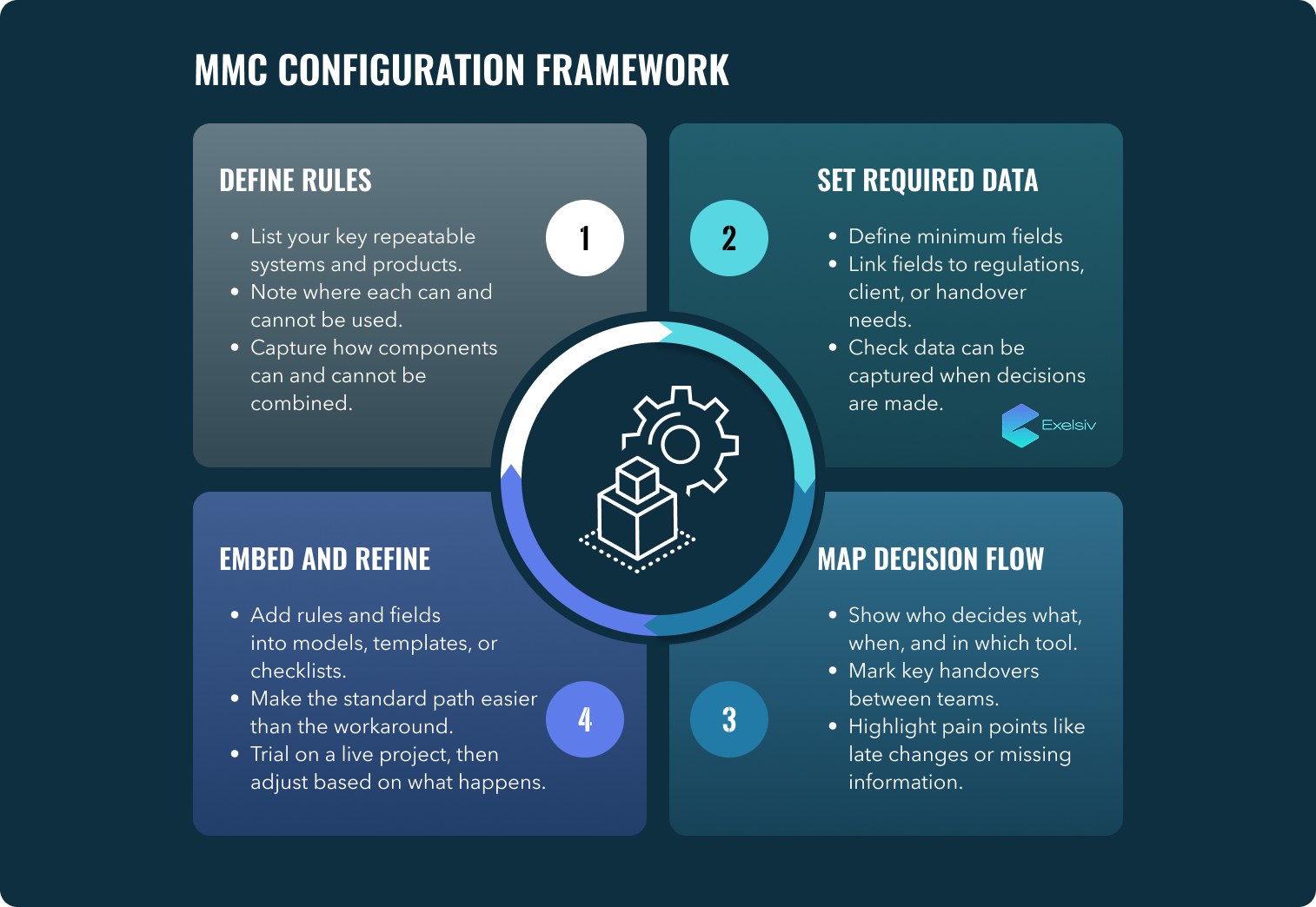
This article outlines the 4‑step MMC configuration framework used in Exelsiv’s MMC Configuration workstream.
Builders and developers using modular and prefabricated systems often keep re-solving the same problems on every project because the rules that govern how those systems work are rarely captured in a reusable, shared way. That leads to repeated coordination issues, compliance gaps, and wasted time, even when teams are experienced and capable.
A lot of the knowledge is already there. It sits in people’s heads, old project files, email chains, mark‑ups, and ad hoc model decisions. The thing is, all those decisions about systems and products rarely turn into a shared, repeatable way of working.
This is where a simple configuration framework helps.
Why this matters
MMC teams make the same types of decisions again and again: what can be used where, what can be combined, what data needs to be captured, who signs off on what, and how those decisions move through design, procurement, and delivery. When that logic is not formalised, each new project starts closer to first principles than it should.
The result is familiar. Teams spend time rechecking the same assumptions, rebuilding the same decision paths, and patching information gaps later in the job. Even good digital tools cannot fix that on their own, because tools only help once the rules, data, and handovers are clear enough to embed.
The 4 steps
A practical way to start is to work through four high-level steps:
Define Rules
Set Required Data
Map Decision Flow
Embed and Refine
Taken together, these four steps turn repeated decisions about systems and products into a shared way of working, rather than something each project team has to recreate from scratch. They also give teams a simple structure for spotting where rules, data, or handovers are currently missing or unclear.
1. Define rules
Start by listing the MMC products and processes that repeat across projects. Then write down where each can and cannot be used, what it can be combined with, and the standard combinations or edge cases your team already knows from experience.
This step sounds simple, but it is often where the biggest hidden value sits. Once those rules are explicit, they stop being dependent on memory, seniority, or whoever happens to be in the room that day.
2. Set required data
For each repeat decision, determine the minimum information that needs to be recorded when the decision is made. Tie those fields back to something that matters, such as regulatory obligations, client requirements, or basic project reporting, so the data has a clear purpose rather than becoming admin for its own sake.
Just as importantly, check that the data can actually be captured at the point where decisions happen. If the required information can only be filled in later, by someone else, in another tool, the structure will break down quickly.
3. Map decision flow
Next, map who makes which decisions, at what stage, and in which tools. Mark the key handovers where information is meant to move between teams, and highlight where things currently break down, such as late changes, duplicated inputs, or missing approvals.
This helps teams see the configuration system they already have, even if it is informal and messy. Once the real decision flow is visible, it becomes much easier to improve it deliberately instead of reacting to each issue one by one.
4. Embed and refine
Finally, build the rules and fields into your models, templates, and digital tools. The aim is to make the standard path easier to follow than the workaround, so the right behaviour is supported by the way work actually gets done.
Then, trial the framework on live work, learn from what happens in practice, and update the rules and fields accordingly. That is how a framework moves from a nice idea to an operational default.
A quick self-check
If you want a simple sense of where your current MMC configuration approach stands, these five questions are a useful starting point:
Are the main rules for your MMC products and systems written down in one place?
Are those rules applied consistently across projects?
Is the minimum useful data recorded when key decisions are made?
Are lessons from one project carried into the next?
Is there clear ownership of the rules, data, and workflow?
If several of those answers are “no”, you probably do not have a shared system for making and reusing MMC decisions, even if the right expertise is already in the business.
What this framework is, and what it is not
This framework is not a full operating model, but a practical way to think about the problem and to see where deeper work is needed across rules, data, handovers, and tools.
That distinction matters. Most teams do not need more theory. They need a clear way to identify what should be standardised, what information matters, where decisions are breaking down, and how those decisions can be embedded into day-to-day delivery without creating more friction.
Most teams can see themselves in this framework straight away. Where they usually get stuck is finding the time and focus to run the conversations, make the trade‑offs, and translate decisions into rules, data structures, and workflows that actually fit their projects and tools. That is the work Exelsiv leads: turning this simple structure into a configuration standard your team can own and keep using.
Download the free framework
If this feels familiar, you do not need another 80‑page report. You need a simple way to talk about rules, data, decision flow, and tools in one conversation.
That is why this MMC configuration framework is available as a free download. It turns these four steps into a simple one‑pager you can use in internal conversations, workshops, or pilot projects.
If you would like help applying it on a live project, Exelsiv runs a focused discovery and design sprint that takes you from “rough idea” to a documented configuration framework, ready to implement in your own tools.
Contact us to see whether this framework makes sense for your current MMC pipeline.
